Standards Alignment
The experiences of participation in authentic research inquiry and presentation at the IJAS Exposition aligns with the first dimension of the Next Generation Science Standards (NGSS), the College Readiness Standards (CRS), and the Common Core State Literacy in Science and Technical Subjects and Writing, and Writing for Literacy in Science and Technical Subjects: Research to Build and Present Knowledge.
On this page
Next Generation Science Standards
As students progress through a research investigation they will engage in the first dimension of the NGSS, which involves the processes of science. This dimension relates to the behaviors that scientists engage in as they investigate and build models and theories about the natural world and the key set of engineering practices that engineers use as they design and build models and systems.
- Asking Questions and Defining Problems
- 1a. Ask and evaluate questions that challenge the premise of an argument, the interpretation of a data set, or the suitability of a design.
- Developing and Using Models
- 2a. Develop a model based on evidence to illustrate the relationships between systems or between components of a system.
- Planning and Carrying Out Investigations
- 3a. Design an investigation individually and collaboratively and test designs as part of building and revising models, supporting explanations for phenomena, or testing solutions to problems. Consider possible confounding variables or effects and evaluate the investigation’s design to ensure variables are controlled.
- 3b. Design and conduct an investigation individually and collaboratively, and in the design: decide on types, how much, and accuracy of data needed to produce reliable measurements and consider limitations on the precision of the data (e.g., number of trials, cost, risk, time), and refine the design accordingly.
- 3c. Design and conduct investigations and test design solutions in a safe and ethical manner including considerations of environmental, social, and personal impacts.
- Analyzing and Interpreting Data
- 4a. Use tools, technologies, and/or models (e.g., computational, mathematical) to generate and analyze data in order to make valid and reliable scientific claims or determine an optimal design solution.
- 4b. Evaluate the impact of new data on a working explanation of a proposed process or system.
- Using Mathematics and Computational Thinking
- 5a. Use mathematical representations of phenomena to describe explanations.
- Constructing Explanations and Designing Solutions
- 6a. Make quantitative and qualitative claims regarding the relationship between dependent and independent variables.
- 6b. Apply scientific reasoning, theory, and models to link evidence to claims to assess the extent to which the reasoning and data support the explanation or conclusion.
- Engaging in Argument from Evidence
- 7a. Evaluate the claims, evidence, and reasoning behind currently accepted explanations or solutions to determine the merits of arguments.
- 7b. Evaluate the evidence behind currently accepted explanations to determine the merits of arguments.
- Obtaining, Evaluating, and Communicating Information
- 8a. Produce scientific and/or technical writing and/or oral presentations that communicate scientific ideas and/or the process of development and the design and performance of a proposed process or system.
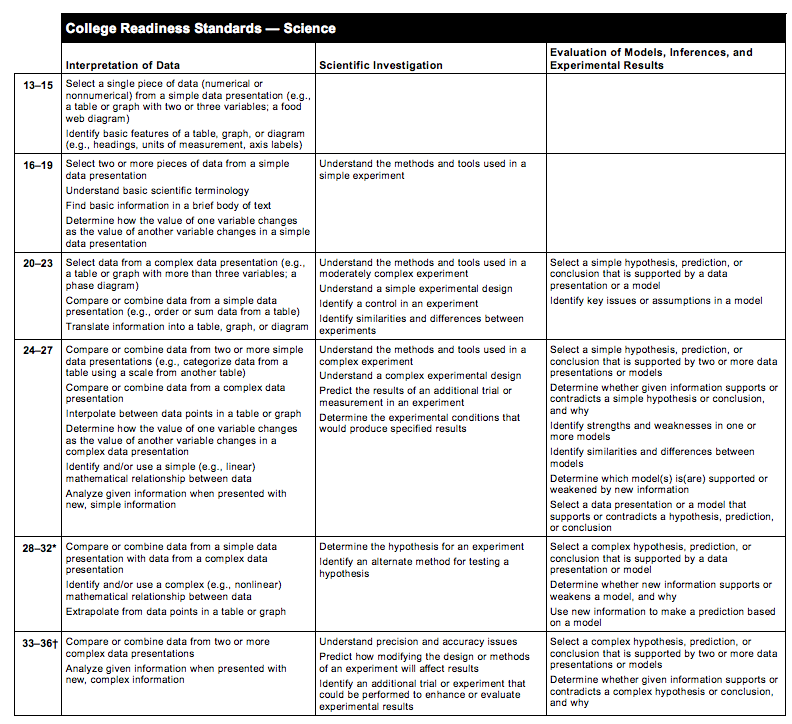
College Readiness Standards (CRS)
Engaging in authentic research investigations addresses the process standards of the College Readiness Standards (CRS), which align to the process of inquiry. The three CRS standards include:
- Interpretation of data,
- Scientific Investigation, and
- Evaluation of Models, Inferences, and Experimental Results
Common Core State Standards
Common Core Reading
Literacy in Science and Technical Subjects
Key Ideas and Details
RST.11-12.1 Cite specific textual evidence to support analysis of science and technical texts, attending to important distinctions the author makes and to any gaps or inconsistencies in the account.
RST.11-12.2 Determine the central ideas or conclusions of a text; summarize complex concepts, processes, or information presented in a text by paraphrasing them in simpler but still accurate terms.
RST.11-12.3 Follow precisely a complex multistep procedure when carrying out experiments, taking measurements, or performing technical tasks; analyze the specific results based on explanations in the text.
Craft and Structure
RST.11-12.4 Determine the meaning of symbols, key terms, and other domain-specific words and phrases as they are used in a specific scientific or technical context relevant to grades 11-12 texts and topics.
RST. 11-12.5 Analyze how the text structures information or ideas into categories or hierarchies, demonstrating understanding of the information or ideas.
RST. 11-12.6 Analyze the author’s purpose in providing an explanation, describing procedure, or discussing an experiment in a text, identifying important issues that remain unresolved.
Integration of Knowledge and Ideas
RST.11-12.7 Integrate and evaluate multiple sources of information presented in diverse formats and media (e.g., quantitative data, video, multimedia) in order to address a question or solve a problem.
RST.11-12.8 Evaluate the hypotheses, data, analysis, and conclusions in a science or technical text, verifying the data when possible and corroborating or challenging conclusions with other sources of information.
RST.11-12.9 Synthesize information from a range of sources (e.g., texts, experiments, simulations) into a coherent understanding of a process, phenomenon, or concept, resolving conflicting information when possible.
Common Core Writing
Writing for Literacy in Science and Technical Subjects: Research to Build and Present Knowledge
W.11-12.7. Conduct short as well as more sustained research projects to answer a question (including a self-generated question) or solve a problem; narrow or broaden the inquiry when appropriate; synthesize multiple sources on the subject, demonstrating understanding of the subject under investigation.
W.11-12.8 Gather relevant information from multiple authoritative print and digital sources, using advanced searches effectively; assess the strengths and limitations of each source in terms of the specific task, purpose, and audience; integrate information into the text selectively to maintain the flow of ideas, avoiding plagiarism and overreliance on any one source and following a standard format for citation.
W.11-12.9. Draw evidence from informational texts to support analysis, reflection, and research.
Common Core Mathematics
Standards for Mathematical Practice
- Make sense of problems and persevere in solving them
- Reason abstractly and quantitatively
- Construct viable arguments and critique the reasoning of others
- Model with mathematics
- Use appropriate tools strategically
- Attend to precision
- Look for and make use of structure
- Look for and express regularity in repeated reasoning